19
SEP 2026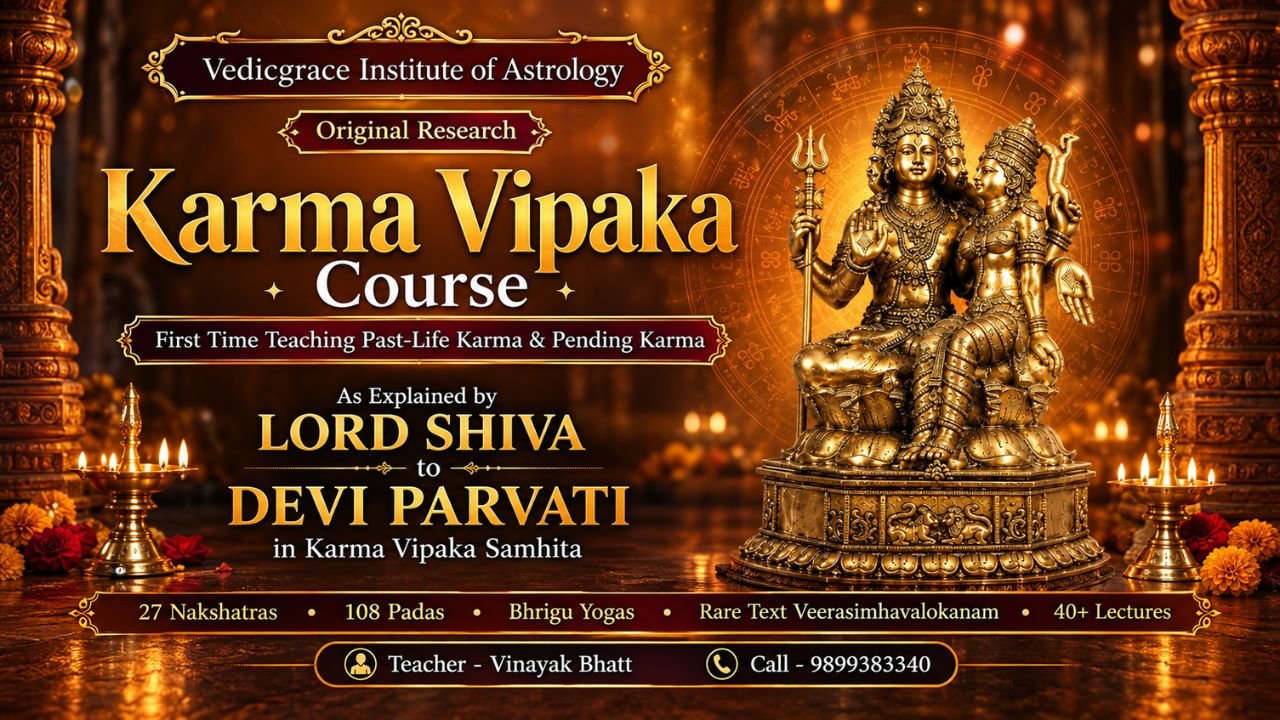
Most Jyotish students look at a difficult Saturn, Rahu, Ketu or 8th lord and immediately say, “Past-life karma.” But this sentence explains almost nothing.
What karma? Why this particular result? Why through marriage and not money? Why through the father and not the mother? Why at 34 and not at 24? And why do two people with apparently similar planetary combinations experience completely different stories? This is where Karma Vipāka becomes one of the most fascinating missing links in predictive Jyotish.
The Bhagavad Gītā gives a warning which every astrologer should keep on his desk: “गहना कर्मणो गतिः — gahanā karmaṇo gatiḥ”, the movement of karma is extremely difficult to understand. Śrī Kṛṣṇa says we must understand karma, vikarma and akarma because the course of action is deep and subtle.
So when somebody confidently says, “You did this in your last birth, therefore Saturn is doing this now,” I become cautious. If Bhagavān calls karma gahana, how did we solve the person’s last three births in seven minutes?
Patañjali gives us an even sharper key. Yoga Sūtra 2.12 says, “क्लेशमूलः कर्माशयो दृष्टादृष्टजन्मवेदनीयः” — kleśa-mūlaḥ karmāśayo dṛṣṭādṛṣṭa-janma-vedanīyaḥ.
The store of karma has its root in the kleśas and may be experienced in the visible present birth or an unseen future birth. Then in 2.13 he says, “सति मूले तद्विपाको जात्यायुर्भोगाः” — sati mūle tad-vipāko jāty-āyur-bhogāḥ. As long as the root remains, the karma ripens as jāti, āyu and bhoga — the circumstances of embodiment, span of life and the experiences through which life is lived. This word vipāka is important. Karma is one thing; the ripening of karma is another.
Now Jyotish becomes much deeper. The horoscope does not manufacture your karma. It reveals the field through which karmic seeds are capable of ripening. Daśā gives time, graha gives the agency and subject, bhāva gives the field of experience, rāśi gives the environment and manner, Nakṣatra takes us closer to the underlying pattern, and Pada can make that pattern surprisingly specific. This is why I tell students that a horoscope should not be read only as a catalogue of future events. It is a map of karmic manifestation.
This is also why Karma Vipāka Saṁhitā deserves serious study. The text is traditionally presented as a Nakṣatra-Caraṇa-Phala-Darśikā, examining results at the level of Nakṣatra and its individual Caraṇas or Padas. The great value of this approach is that Nakṣatra is no longer reduced to “you are creative, emotional, stubborn, spiritual.” It asks a much more uncomfortable question: What kind of action can produce this particular pattern of experience, and what form of correction is appropriate?
This is the difference between ordinary Nakṣatra astrology and Karma Vipaka thinking. If somebody repeatedly loses trust in relationships, I am not satisfied by saying, “Your Venus is afflicted.” I want to know why trust repeatedly becomes the theatre of karma. If another person repeatedly earns money and then suddenly loses it, I do not stop at the 2nd and 11th houses. Why does accumulation repeatedly end in depletion? If a person receives authority but repeatedly quarrels with seniors, why does authority become his karmic battlefield? Events change, people change, cities change, but sometimes the story remains almost identical.
That repeating story is where Karma Vipāka becomes visible.
And Dharmaśāstra gives another important correction to modern ideas of karma. Manu describes karma as arising through mind, speech and body — mano, vāk and deha. It is not necessary to physically strike somebody before karma begins. Intention has a karmic dimension. Speech has a karmic dimension. Action has a karmic dimension. Manu’s discussion even separates mental, verbal and bodily misconduct, showing that karma is not limited to visible physical deeds.
Now apply this to a horoscope. Suppose Mercury repeatedly suffers. Before inventing a dramatic previous-life story, ask about speech. Has the native repeatedly lied, manipulated, insulted, promised and withdrawn, spread information carelessly or used intelligence against others? Suppose Moon suffers. Examine the mental patterns which are being fed every day. Suppose Mars suffers. Examine action, aggression, injury, competition and the misuse of physical power.
Suppose Venus suffers. Examine agreements, relationships, pleasure, sexuality, gratitude and what the native takes from others emotionally. Saturn may expose neglected duty, exploitation, abandonment or refusal to carry legitimate responsibility. Jupiter may expose misuse of knowledge, advice, teaching, faith or authority. Suddenly “karma” stops being a mystical word and becomes observable.
There is another mistake we make. We assume bad karma must produce something visibly bad and good karma must immediately produce comfort. But karma is not that childish. Sometimes what looks like loss saves the person from a greater fall. Sometimes a delay matures the person. Sometimes success activates arrogance and becomes the beginning of future suffering. Sometimes humiliation destroys false identity and becomes spiritually valuable. This is exactly why Kṛṣṇa says gahanā karmaṇo gatiḥ. We see one frame; karma may be operating through the whole film.
Patañjali gives us another profound clue in 2.14: karmic fruition carries pleasure or pain according to पुण्य and अपुण्य. But notice something important: the Yoga Sūtra does not merely teach us how to enjoy good karma and escape bad karma. It goes towards destroying the root itself. If kleśa — avidyā, asmitā, rāga, dveṣa and abhiniveśa — keeps producing action, then simply changing external circumstances cannot finish the karmic factory.
This has enormous importance for Jyotish remedies. Suppose Rahu repeatedly produces obsession and I perform a remedy, but my rāga, my compulsive wanting, remains untouched. Have I finished Rahu’s problem? Suppose Saturn brings painful consequences of avoidance, but I continue avoiding responsibility. Suppose Mars creates conflict, and after every pūjā I return home and insult the same people. We may be doing remedies for karma while manufacturing fresh karma faster than the remedy can work.
That is why real Prāyaścitta is not simply “perform this ritual and account closed.” Dharmaśāstra gives repentance, restraint and not repeating the action an important place. Manusmṛti 11.231 makes the principle very practical: purification involves the resolve, in effect, “I shall not do this again.” If behaviour does not change, we should at least question whether the karmic root has really been addressed.
This gives us a very useful model for predictive Jyotish: Graha → Nakṣatra → Pada → repeated life situation → repeated inner response → karmic root → appropriate correction. Do not jump directly from planet to past life. First observe the present life carefully. Karma often leaves fingerprints everywhere.
And sometimes the greatest proof of previous karma is not a spectacular event. It is an irrational repetition. “Why do I always choose this kind of person?” “Why does money leave me in the same way?” “Why do I become angry only with authority?” “Why do I save everybody and then resent them?” “Why do I abandon opportunities exactly when success comes close?” When the same script keeps finding new actors, a Jyotishi should become very attentive.
This is where Nakṣatra Pada study becomes extraordinary. A Pada can behave almost like a small karmic room inside the horoscope. The planet entering that room carries its own kārakatva, but it must operate through the story, Devatā, rāśi/navāṁśa background and karmic environment of that Pada. The graha tells us who is acting; the Pada can tell us what kind of old script that actor has entered.
Therefore I do not like saying, “Your horoscope is bad because you have bad karma.” That is poor Jyotish and poor philosophy. A horoscope is not a punishment certificate issued by Bhagavān. It is closer to a karmic diagnostic map. It shows where something has ripened, where something is still being produced, and—most importantly—where conscious action can begin changing the future chain.
Now I want students to do a more serious experiment. Forget “good planet” and “bad planet” for a moment. Look at your Moon Nakṣatra and Pada, Lagna Nakṣatra if known, and the planet giving you the most repeated difficulty in life. Then identify just one repeating story. Not an event — a story.
Write in the comments: your Moon Nakṣatra + Pada + one situation which has repeated at least three times in your life. Relationship, money, family, authority, betrayal, responsibility, health, education, property, speech, career — anything.
Then ask yourself the real Karma Vipāka question: “Why does life keep bringing me the same lesson wearing different clothes?”
That question, properly understood, may take us much deeper into Jyotish than simply asking, “When will my good time start?”
Jai Guru Dev
Vinayak Bhatt