19
SEP 2026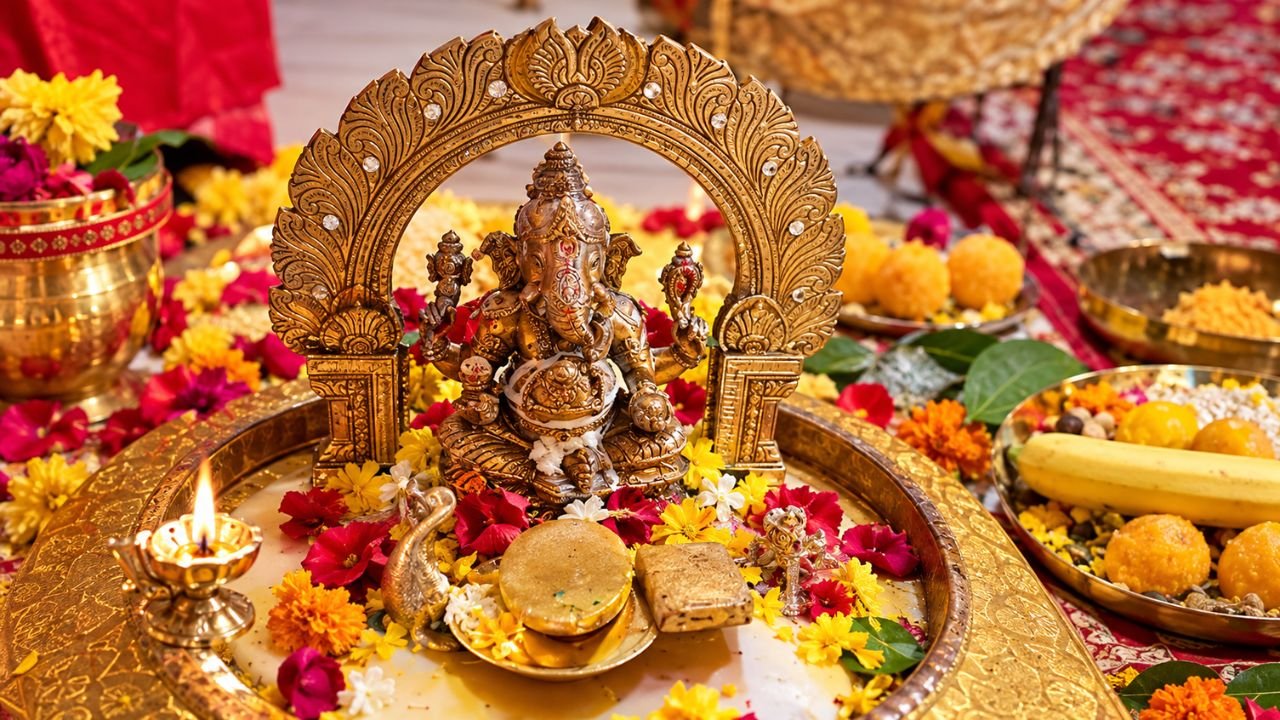
There is one line in the Gaṇapati Atharvaśīrṣa which most people recite very quickly, but for a Jyotishi this one line deserves serious attention: “अनेन गणपतिमभिषिञ्चति स वाग्मी भवति” — Anena Gaṇapatim abhiṣiñcati sa vāgmī bhavati.
The text itself says that one who performs Abhiṣeka of Gaṇapati with this Atharvaśīrṣa becomes *vāgmī* — capable and accomplished in speech. Now stop here. Why should pouring water over a Gaṇapati mūrti while chanting a mantra affect Vāk — speech? If we understand this question, Atharvaśīrṣa starts opening like a Jyotish text.
Atharvaśīrṣa does not introduce Gaṇapati merely as one deity sitting outside us and removing worldly obstacles. It begins with the extraordinary declaration “त्वमेव प्रत्यक्षं तत्त्वमसि… त्वमेव केवलं कर्ताऽसि, त्वमेव केवलं धर्ताऽसि, त्वमेव केवलं हर्ताऽसि” — You are the directly perceptible Tattva; You are the doer, sustainer and dissolver. Later it says, “त्वं वाङ्मयस्त्वं चिन्मयः… त्वं ज्ञानमयो विज्ञानमयोऽसि” — You are the very nature of Vāk, consciousness, knowledge and discriminative knowledge.
So when the Phalaśruti connects Atharvaśīrṣa Abhiṣeka with becoming vāgmī, it is not an accidental promise placed at the end of the text. Vāk has been present inside the philosophy of the mantra from the beginning.
And now Jyotish becomes interesting. When a client cannot express what he knows, do we immediately blame Mercury? When knowledge is present but speech does not carry authority, is it only Budha? When a person speaks brilliantly but nobody trusts his words, what about Jupiter? When emotions destroy clarity of speech, what about Moon? When anger enters speech, Mars begins speaking through the tongue.
When fear makes a person silent before authority, Saturn appears. When exaggeration enters speech, Rahu appears. And when the person suddenly cuts conversation, gives incomplete answers or withdraws completely, Ketu can colour Vāk. Speech may be represented strongly through Mercury, but the final spoken word is carrying the entire horoscope.
This is why I do not see Atharvaśīrṣa Abhiṣeka merely as “do this for removing obstacles.” There is a much deeper architecture here. During Abhiṣeka there is a continuous stream of dravya, and simultaneously there is a continuous stream of mantra. One stream touches the form of Gaṇapati; the other stream starts disciplining the mind, breath, pronunciation, attention and Vāk of the sādhaka. Water is flowing outside, but something should also begin flowing correctly inside.
Now notice another remarkable passage: “त्वं भूमिरापोऽनलोऽनिलो नभः। त्वं चत्वारि वाक्पदानि।” Gaṇapati is described through the five great elements — earth, water, fire, air and space — and immediately the text speaks of the four stages of Vāk..
For a Jyotish student this should ring a bell. Our entire horoscope manifests through tattva. Grahas do not operate somewhere in empty space; their karma ultimately reaches body, mind, speech, action, relationships and experience through embodied nature.
And this is why Abhiṣeka is such a beautiful ritual technology. The physical action is simple enough for the body to participate, mantra engages Vāk, meaning engages Buddhi, repetition engages memory, Sankalpa directs the mind, and the Devatā gives the entire process one centre. When all these are together, the remedy is no longer “wear something and hope the planet becomes good.” The native himself is participating in the correction.
Atharvaśīrṣa then goes much further. “त्वं गुणत्रयातीतः। त्वमवस्थात्रयातीतः। त्वं देहत्रयातीतः। त्वं कालत्रयातीतः।” Ganapati is declared beyond the three guṇas, three states, three bodies and three divisions of time.
Then comes “त्वं मूलाधारस्थितोऽसि नित्यम्” — You are eternally established in Mūlādhāra. Think like a Jyotishi here. We spend our lives reading kāla through Daśā, transit, Tithi, Nakṣatra and Muhūrta; but the Devatā invoked here is described as beyond Kāla itself. That is why a genuine remedy is not simply an attempt to escape one bad period. Its deeper purpose is to bring the consciousness of the person into a position from where the period can be handled correctly.
There is another line students should meditate on: “त्वं सूर्यस्त्वं चन्द्रमाः” — You are Surya and You are Chandra. The two great luminaries through which Jyotish measures life, consciousness, mind, time and experience are included within Ganapati Tattva itself. This is why I would be very cautious before reducing Ganapati worship to “Mercury remedy” or “Ketu remedy.” Ganapati is much larger than one planetary correspondence. A Devatā should not be imprisoned inside one graha just because modern astrology needs an easy table.
Now understand why Abhiṣeka can become powerful for Jyotish practice. Suppose the Moon is disturbed. During Abhiṣeka, can the mind remain with one mantra continuously or does it wander every twenty seconds? Suppose Mercury is disturbed. Can you pronounce correctly, maintain sequence and understand what you are uttering? Suppose Saturn is troublesome. Can you repeat the practice regularly without becoming bored? Suppose Mars dominates.
Can you perform slowly and respectfully instead of rushing through 108 repetitions? Suppose Rahu dominates. Can you resist the desire for some “secret advanced mantra” and remain with one authentic Vidyā? Suppose Ketu dominates. Can you remain present instead of mechanically finishing the ritual? Suddenly your behaviour during the remedy itself starts revealing the grahas you are supposedly trying to remedy.
And there is something almost humorous here. We tell Ganapati, “Please remove my Vighna.” Ganapati may be looking at us thinking, “I have been trying. You recreate the same Vighna every morning.” Saturn gives one lesson — we avoid it. Mars creates the same argument — we repeat it. Rahu shows the same temptation — we chase it. Moon develops the same emotional response — we feed it. Then we perform one Abhiṣeka and ask why destiny has not changed.
Perhaps this is why the Atharvaśīrṣa does not stop at “obstacle removal.” Its Phalaśruti speaks of freedom from great obstacles and faults, but it also specifically speaks about Vāk, Vidyā, Medhā and Yaśas in different forms of its practice. The direction is clear: Ganapati does not merely rearrange circumstances. The sādhana is also concerned with making the instrument receiving those circumstances more capable.
So when I perform Gaṇapati Atharvaśīrṣa Abhiṣeka, my Jyotish question is not simply, “Which graha will become favourable?”
My question is deeper: Which internal Vighna is preventing this graha from expressing its higher function? Is Saturn unable to become discipline because it has become fear? Has Mars lost courage and become anger? Has Mercury lost discrimination and become endless thinking? Has Jupiter lost wisdom and become opinion? Has Moon lost sensitivity and become emotional instability? Has Rahu lost ambition and become obsession? Has Ketu lost detachment and become avoidance?
Then Abhiṣeka becomes meaningful. The water washes the mūrti, the mantra washes Vāk, repetition washes habit, and understanding begins washing the wrong identification through which we experience our grahas.
Now I want my Jyotish students to study their own experience rather than giving textbook answers. If you have ever performed Gaṇapati Atharvaśīrṣa Abhiṣeka repeatedly, tell me what changed first — your external situation, your speech, your thinking, your confidence, your concentration, your fear, or your behaviour?
And one more research question for the comments: Which graha in your horoscope do you feel creates your biggest Vighna, and what if Ganapati does not remove that graha’s result but first changes you so that the same graha starts giving a different result?
Write your Lagna + troublesome Graha + your experience with Atharvaśīrṣa or Gaṇapati Abhiṣeka. I am more interested in actual observations than copied astrological rules. This is how Jyotish and Mantra Śāstra should be studied together.
Jai Guru Dev
Vinayak Bhatt
Related Articles
What Ganapati Atharvashirsha Taught Me About the Grahas and Jyotish