16
SEP 2026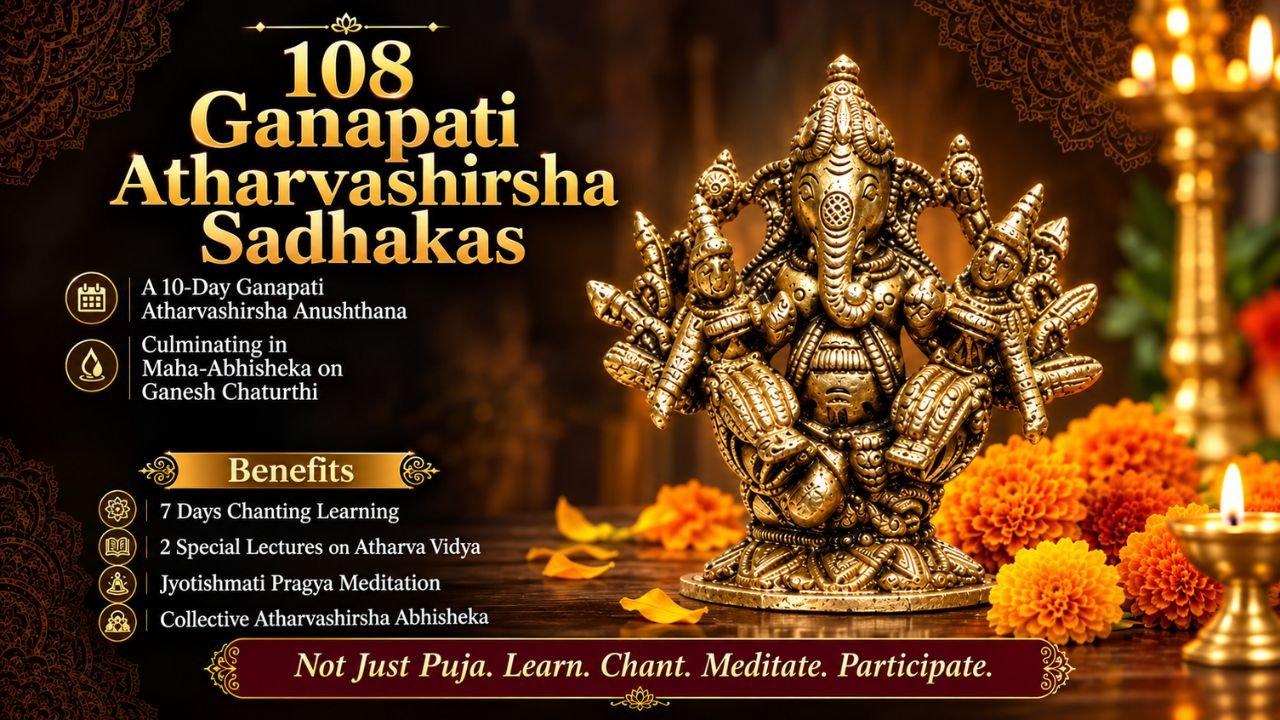
One problem I repeatedly see among Jyotish students is strange. They keep studying more, but prediction does not necessarily become easier. They know houses, Grahas, Nakshatras, Dashas, Yogas and many techniques. Still, when an actual horoscope comes in front of them, the mind starts running in ten directions. Which rule should I use? Which combination is stronger? What should I tell the client? Is this prediction correct or am I imagining it? The problem here may not be lack of Jyotish knowledge. Sometimes the problem is that Buddhi has knowledge, but the mind does not have enough stillness to hold it.
This is where I feel we have understood Ganapati only partially. Since childhood we have been told, “Ganesha removes obstacles.” Correct. But the Ganapati Atharvashirsha gives a much deeper description:
त्वं वाङ्मयस्त्वं चिन्मयः। त्वमानन्दमयस्त्वं ब्रह्ममयः। त्वं ज्ञानमयो विज्ञानमयोऽसि॥
Tvam vāṅmayas tvam cinmayaḥ… tvam jñānamayo vijñānamayo’si.
You are the principle of speech. You are consciousness. You are knowledge, and you are Vijñana — knowledge that has become understood and realised.
Now think like an astrologer. What do we actually need when reading a horoscope? We need information, yes. But information alone does not make an astrologer. We need the ability to connect apparently unrelated things. We need to notice what others miss. We need the patience to remain with the chart until its pattern becomes visible. And finally we need Vak — the right words to express what we have understood.
Atharvashirsha then gives another remarkable statement:
त्वं चत्वारि वाक्पदानि॥
Tvam catvāri vākpadāni.
You are the four stages of Vak.
For a Jyotish student this deserves meditation. Before a prediction becomes spoken language, something happens inside. First there is perception. Then a subtle idea forms. Then the mind gives it structure. Finally it becomes spoken Vak. If our inner process is disturbed, the final prediction can also become disturbed. We may see correctly but speak wrongly. We may know a Yoga but apply it at the wrong level. Or we may speak too quickly before the chart has revealed itself.
Then comes another line which completely changes how we should look at Ganapati Sadhana:
त्वं मूलाधारस्थितोऽसि नित्यम्। त्वं शक्तित्रयात्मकः। त्वां योगिनो ध्यायन्ति नित्यम्॥
Tvam mūlādhārasthito’si nityam… tvāṁ yogino dhyāyanti nityam.
You are eternally established in Muladhara. The Yogis meditate upon You constantly.
Why Muladhara? Because before something can rise, there must be a stable foundation. This principle works in ordinary life also. A disturbed person makes disturbed decisions. A frightened person reads danger everywhere. An impatient astrologer predicts too early. An egoistic astrologer starts trying to prove himself through every chart. Knowledge may be correct, but the instrument receiving that knowledge is not steady.
This is one practical meaning of Atharva Vidya that I want students to understand. Do not only ask, “What does this Mantra give me?” Ask, “What is this Mantra trying to change inside me?”
Ganapati Sadhana can become a discipline of bringing scattered energies back to one centre. Before an important consultation, before writing, before teaching, before beginning a serious study, before making a major decision — first establish the mind. Then observe. Then understand. Then speak.
This is also the reason we are now adding Jyotishmati Pragya Meditation to this Ganapati Atharvashirsha programme.
Meditation is not being added simply as another “bonus class.” It completes the practical idea behind what we are trying to teach. Atharvashirsha gives the Vidya. Chanting gives repetition and internalisation. Meditation trains us to sit with ourselves without immediately reacting. And Abhisheka gives a physical act through which the entire Sadhana is offered back to the Devata.
For a Jyotish student, I would describe the process very simply:
Mantra purifies the flow of thought. Meditation develops Dharana. Atharva Vidya gives understanding. Jyotish gives the field in which that understanding can be tested.
And this is why I do not want this programme to become only another Ganesh Chaturthi Puja.
I want students to actually learn how to chant Ganapati Atharvashirsha, understand what the Rishi is saying, study the deeper Atharva Vidya contained in its statements, experience Jyotishmati Pragya Meditation, and finally participate in the sacred Abhisheka of Ganapati.
Because perhaps the greatest Vighna in our life is not an enemy, a bad transit or an unfortunate situation.
Sometimes the greatest Vighna is our inability to see clearly when the answer is already in front of us.
And therefore Ganapati does not merely remove the stone from your road.
First He works upon the intelligence that must recognise the road.
ॐ नमस्ते गणपतये। त्वमेव प्रत्यक्षं तत्त्वमसि॥
This Ganesh Chaturthi we are conducting our special Ganapati Atharvashirsha Anushthana for 108 Sadhakas, culminating in Maha-Abhisheka on Ganesh Chaturthi.
Along with the Anushthana, participants will receive Ganapati Atharvashirsha chanting and learning, special teaching on the Atharva Vidya contained within the Atharvashirsha, Jyotishmati Pragya Meditation, and participation in the sacred Ganapati Abhisheka.
This programme is especially meaningful for students of Jyotish, Mantra, meditation and traditional Vidya who do not want to merely recite a text, but want to understand what the Rishi is actually trying to awaken within us.
ॐ गं गणपतये नमः॥