
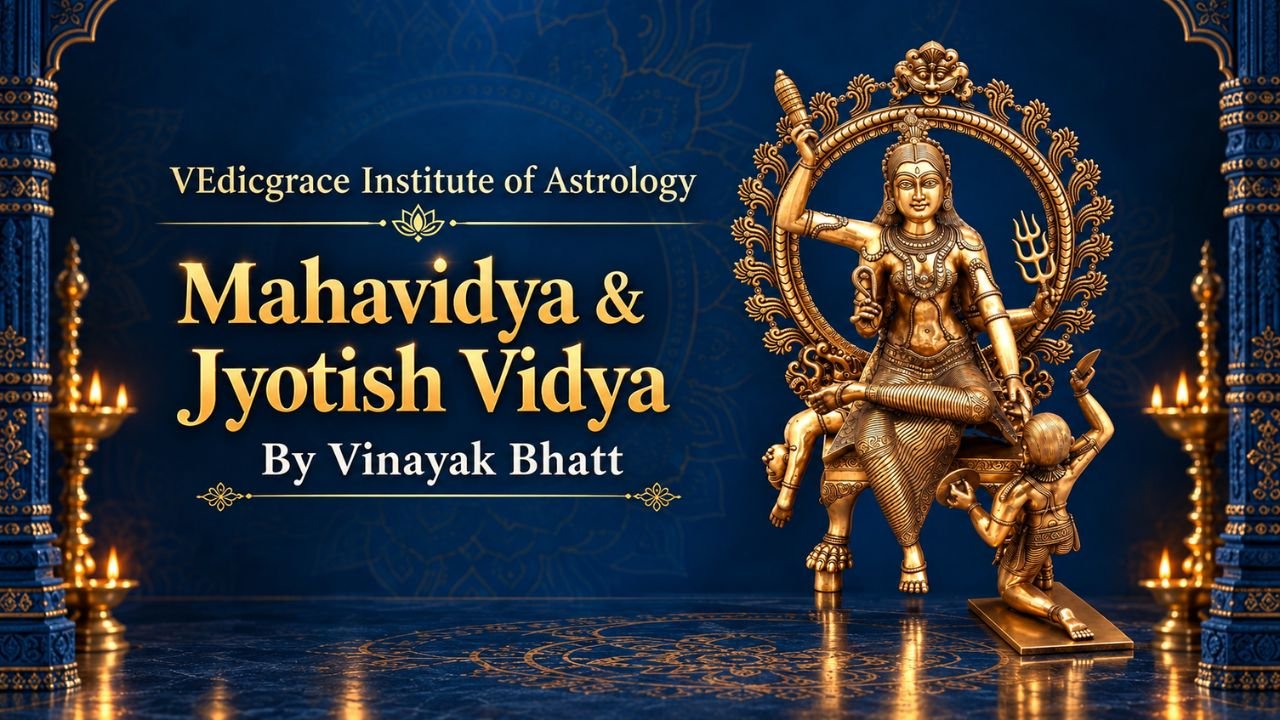
Whenever I see Daśa Mahāvidyā explained on social media, I usually find one convenient table: Kālī for this planet, Tārā for that planet, Bagalāmukhī for enemies, Kamalā for money, and within five minutes one of the deepest Tantric traditions has become a spiritual customer-care department. For a Jyotishi, this approach is especially dangerous because once we put every Devatā inside one Graha-box, we stop thinking.
The Muṇḍamālā Tantra itself names the ten: “काली तारा महाविद्या षोडशी भुवनेश्वरी । भैरवी छिन्नमस्ता च विद्या धूमावती तथा…”, followed by Bagalāmukhī, Mātangī and Kamalātmikā, calling them the ten Mahāvidyās. But notice the word: Mahā-Vidyā- Great Wisdom, not merely “ten powers for fulfilling ten desires.”
Modern scholarship also notices something very unusual about this group. These Goddesses do not fit one comfortable image of what the Divine Feminine “should” look like. Some are beautiful, some terrifying, some connected with death, some with prosperity, some with marginality, some with speech, some with emptiness. David Kinsley’s major study describes them as forms that can act almost like awakeners, pushing consciousness beyond socially comfortable and predictable categories. And this is where Mahāvidyā becomes extremely interesting for Jyotish.
A horoscope is also full of things we like and things we do not like. We love Jupiter in the 9th. We become nervous about Saturn in the 8th. We want Venus to give pleasure but do not want Venus to expose our attachment. We want Mars to give courage but not conflict. We want Rahu to give success but not obsession. We want Ketu to give spirituality but definitely not separation. In other words, we want half of reality.
Mahāvidyā does not allow that luxury. She asks us to look at beauty and decay, wealth and poverty, speech and silence, desire and renunciation, creation and destruction, fullness and emptiness – and recognise that all of these belong to the field of existence.
Bhagavad Gītā gives a powerful clue here: “दैवी ह्येषा गुणमयी मम माया दुरत्यया” – this Divine Māyā constituted of the Guṇas is difficult to cross. And a few verses later Kṛṣṇa says beings become deluded through icchā and dveṣa – attraction and aversion.
Now read that like a Jyotishi. Perhaps the problem is not only Saturn. Perhaps the problem is my dveṣa towards the experience Saturn is bringing. Perhaps the problem is not only Venus. Perhaps the problem is my rāga towards the pleasure Venus represents. Perhaps Rahu is not only creating desire. Perhaps Rahu is exposing how easily desire controls my discrimination.
This comes very close to Patañjali. Yoga Sūtra 2.3 gives the five Kleśas: Avidyā, Asmitā, Rāga, Dveṣa and Abhiniveśa – ignorance, ego-identification, attachment, aversion and deep clinging. The traditional commentary connects these Kleśas with the stream that ultimately brings about karma and its Vipāka.
Now suddenly Daśa Mahāvidyā can be understood in a much more practical way.
KĀLĪ begins where our obsession with continuity ends. Kāla takes everything – position, youth, relationship, status, even the body. Whenever a horoscope enters a period where an identity is being destroyed, most people immediately ask, “How can I stop this?” Kālī asks a different question: “What exactly are you afraid will die?” This is a very important question during Saturn, Ketu, 8th-house and severe transformational periods – not because I am saying “Kālī equals Saturn or Ketu,” but because her Tattva can help us understand what Time is doing. Sometimes Saturn is not destroying your career. It is destroying your belief that your career is your entire identity. That is a completely different prediction.
TĀRĀ carries another wisdom. The very experience of life sometimes feels like crossing something – grief, uncertainty, transition, loss of direction. A client comes and says, “My old life has finished, but the new life has not started.” Most astrologers desperately want to predict the next event. Tārā asks whether wisdom can carry the person across the gap. Every transition does not need an immediate answer. Sometimes it needs a boat.
TRIPURASUNDARĪ or ṢOḌAŚĪ gives another lesson which many spiritual people misunderstand. Spirituality is not always hatred of beauty, pleasure and desire. The question is whether desire is unconscious or properly ordered. Beauty can bind, but beauty can also reveal harmony.
Venus can give attraction, but a mature Venus can understand proportion, relationship and refinement. So when I study excessive Venusian desire in a horoscope, I do not simply say “control your Venus.” The deeper question is: Can desire become refined enough that it stops ruling you? This is where Tripurasundarī becomes a profound meditation on desire rather than a simple promise of enjoyment.
BHUVANEŚVARĪ teaches me something extremely useful in horoscope reading: before judging an event, understand the space in which that event is happening. Bhuvana means world, field, manifested space. In Jyotish also, Bhāva is a field. A planet cannot be understood without knowing where it has been placed. Mars in the 3rd is not Mars in the 7th. Saturn in the 6th is not Saturn in the 4th. And psychologically this is also true. Sometimes the person does not need another solution.
He needs space. Space before replying. Space before resigning. Space before ending the marriage. Space between emotion and action. Many disasters in a horoscope happen because there was no inner Bhuvaneśvarī – no space between stimulus and response.
BHAIRAVĪ is where spirituality stops being decorative. Everybody loves mystical knowledge until tapas begins. Waking regularly. Repeating the same practice. Controlling speech. Keeping a vrata. Doing the difficult thing even when nobody is watching. Mars can give intensity for three days. Rahu can create fascination for three weeks. But real Sādhanā asks whether that fire can be maintained without burning the person himself. This is why I see Bhairavī as an important contemplation whenever a chart has tremendous energy but no discipline. Power without tapas becomes leakage.
CHINNAMASTĀ is perhaps one of the most misunderstood Mahāvidyās because her image is shocking. But that shock itself is part of the teaching. The self-severed head forces us to ask a very uncomfortable question: Is the head always the master? The mind says, “I want.” The ego says, “I deserve.” Mercury says, “I can justify it.” Rahu says, “More.” And sometimes one clean interruption of that mental chain changes destiny.
Bhagavad Gītā 2.62–63 gives a frighteningly accurate behavioural sequence: contemplation produces attachment, attachment produces desire, frustrated desire produces anger, then delusion, disturbed memory and destruction of discrimination.
A Jyotishi should memorise this psychological Daśā sequence also. Sometimes before predicting the next external event, ask where the person needs to cut the chain.That is where Chinnamastā becomes practical.
DHŪMĀVATĪ is one of the greatest teachers for astrologers because she represents something modern spirituality dislikes discussing: what remains when what we wanted does not happen? No marriage. No promotion. No child at the expected time. Loss. Loneliness. Old age. Disappointment. A dream which simply died. Most remedies are sold with one promise: “You will get what you want.”
Dhūmāvatī asks: “And if you don’t?” Can wisdom exist even there? This is extremely important when reading difficult Saturn, 8th, 12th, Ketu or severe Vipāka periods. Again, I am not equating Dhūmāvatī with these placements. I am saying her Vidyā teaches us how to understand absence itself.
Sometimes the biggest spiritual change begins not when life gives us something, but when life refuses to give it. BAGALĀMUKHĪ is usually marketed as “stop your enemies.” But before stopping the enemy’s tongue, perhaps ask whether we can stop our own tongue. That would already solve half the 2nd-house and Mercury problems I see. A message arrives. Mars reacts. Moon becomes emotional. Rahu exaggerates. Mercury prepares a 900-word reply.
And somewhere Bagalā says: STOP. That moment of Stambhana – interruption – can save a relationship, lawsuit, career and reputation. This is practical Bagalā Tattva for a Jyotish student: before using the chart to control another person, learn to recognise what inside yourself needs to be stopped.
MĀTANGĪ brings us into the territory of Vāk, knowledge, art and also what respectable society may push outside its boundaries. In many traditions she carries associations with marginality and unconventional knowledge, which is one reason simplistic “Tantric Sarasvatī” descriptions do not capture her full complexity.
For an astrologer this is fascinating. Where does knowledge come from? Only from respectable books? Only from a famous teacher? Can wisdom also come through the person society ignored? Can a client teach the astrologer something his textbook never taught him? Can one unusual chart destroy twenty years of rigid theory? Mātangī reminds me that sometimes wisdom enters through the door our ego has labelled “unacceptable.” And she raises another question about Vāk: Is your speech merely knowledgeable, or does it carry truth?
A Jyotishi can know 500 combinations and still use speech badly.
That is not Vidyā. KAMALĀ brings us finally to prosperity. And this is another place where Jyotish becomes childish very quickly. “Which Yoga gives crores?” “Which planet gives luxury cars?” “Which mantra gives wealth?”
But Lakṣmī standing on the lotus is teaching something more delicate. A lotus grows in water but remains above it. Can wealth remain with you without entering your head? Can Venus give comfort without destroying restraint? Can Jupiter expand assets without expanding arrogance? Can the 11th house give gains without converting every relationship into networking? Can the 2nd house grow without making family only about inheritance? This is where Kamalā becomes far more difficult than merely becoming rich. To possess wealth is one thing. To remain inwardly unpossessed by wealth is another.
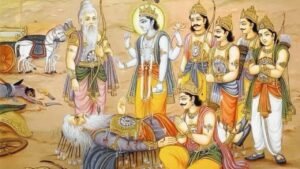
And this brings me to something Mahābhārata teaches repeatedly: “यतो धर्मस्ततो जयः – where Dharma is, there is victory.” The phrase occurs repeatedly in the epic. Power alone is not victory. Victory separated from Dharma eventually becomes another form of defeat.
Rāmāyaṇa says something equally important about Śrī Rāma: “रामो विग्रहवान् धर्मः” – Rāma is Dharma embodied.
Why are these two references important in a discussion on Mahāvidyā? Because Śakti without Dharma can easily become ego with supernatural vocabulary “I want control.” “I want Siddhi.” “I want attraction.” “I want to defeat my enemy.” “I want everybody to listen to me.” That may be desire for power. It is not automatically spiritual growth. A real Mahāvidyā tradition therefore cannot be learnt merely by downloading ten mantras from the internet.
The Muṇḍamālā Tantra itself places Devatā, Guru and Mantra in one integral relationship, and elsewhere stresses Guru’s grace in the context of initiation.
This is why I would tell Jyotish students very clearly: study the Tattva freely, contemplate the symbolism deeply, but do not casually experiment with esoteric Mantra-Sādhanā because somebody uploaded a “powerful secret mantra” on YouTube.
Tantra without Paramparā can quickly become imagination. And now comes the most important Jyotish point.
I do not accept a universal rule that Kālī must equal one particular Graha, Tārā another, Ṣoḍaśī another, until the textual tradition being used is clearly stated. Tantric texts themselves contain different networks of correspondences. Even traditional associations between the Mahāvidyās and other sets such as the Daśāvatāras vary across texts. Academic study of the tradition also shows that the ten forms bring together diverse streams rather than one simple uniform system.
For Jyotish, I find something else far more useful. Do not ask first, “Which Mahāvidyā is my Saturn?”
Ask:
When Saturn takes something away, which Vidyā is life forcing me to understand? When Rahu makes me obsess, which part of consciousness needs Vidyā? When Venus makes me attach, what am I actually seeking? When Mars makes me react, what must be stopped? When Ketu disconnects me, what identity has completed its purpose? When Jupiter gives abundance, can I carry it without ego? When Moon becomes disturbed, which reality am I refusing to accept?
Then Mahāvidyā stops being a remedy chart. It becomes a way of reading consciousness through the horoscope. Perhaps this is why these forms are sometimes so frightening. They are not necessarily frightening because Devi is angry.
Maybe they are frightening because Truth is standing in a form from which our ego cannot escape.
Kālī asks you to face Time. Tārā asks whether you can cross. Tripurasundarī asks whether desire can become wisdom. Bhuvaneśvarī asks whether you can create space. Bhairavī asks whether you can tolerate Tapas. Chinnamastā asks whether you can interrupt the ego. Dhūmāvatī asks who you are when life gives you nothing. Bagalāmukhī asks whether you can stop before reacting. Mātangī asks whether truth can come from where you least expect it. Kamalā asks whether prosperity can come without possession of your consciousness.
These are not ten easy questions.
That is why they are Mahā-Vidyā. Now I want Jyotish students to answer something deeper than “My favourite Goddess is Kālī.”
Look at the most difficult pattern in your own horoscope and life.
Then tell me:
Which one Mahāvidyā best describes the WISDOM you think that pattern is trying to teach you?
Not which Goddess will remove your problem.
Which Goddess helps you understand the problem?
Write your Lagna + troublesome Graha or Bhāva + one Mahāvidyā + your Jyotish logic.
And one final question:
If a difficult Graha repeatedly brings the same lesson, is the Graha really your enemy — or is it repeatedly taking you to the door of a Vidyā which you have still refused to learn?
Think about this before answering.
Because perhaps the greatest secret of Daśa Mahāvidyā is not that Devi gives us ten different powers.
Perhaps She gives us ten different ways to stop lying to ourselves.
Jai Guru Dev
Vinayak Bhatt