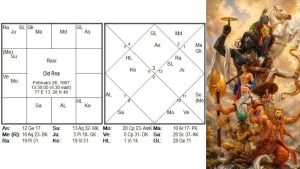

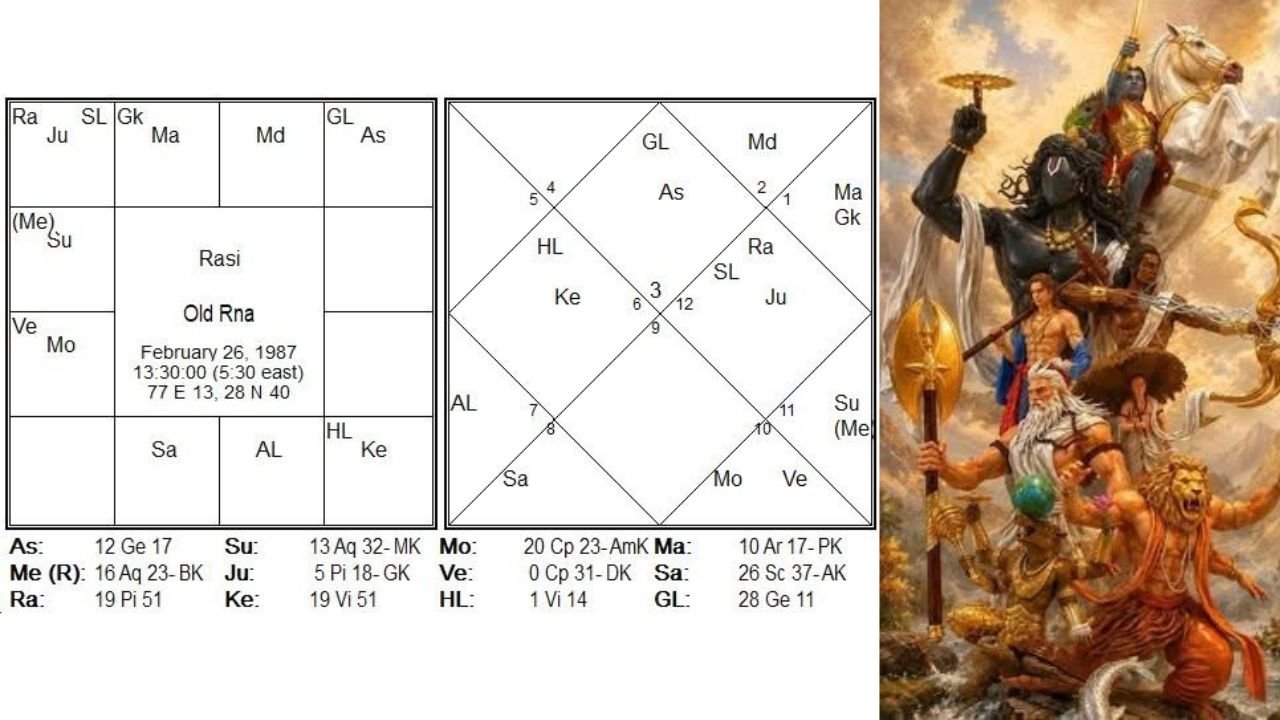
Date – 26 Feb 1987 , 1:30 PM IST , Delhi India
This horoscope should first be read from the principle of Ṛṇa and Dharma, not merely from good and bad planetary placements. Karma Vipāka Saṁhitā itself explains that Nakṣatra-pada is a doorway to past Sañcita Karma, but the entire horoscope must support the conclusion; it is not correct to mechanically give the same past-life story to every person born in one pada.
Veerasimhāvalokanam follows a similar classical approach: first understand the hidden karmic cause, then identify its astrological manifestation, and finally prescribe correction through conduct, japa, homa, dāna and, where relevant, treatment. Here Mithuna Lagna rises in Ārdrā Pada 2, whose Navāṁśa is Capricorn, bringing Rahu’s storm under Saturn’s law of repayment. Lagna lord Mercury is retrograde in the 9th with Sun, while the 9th lord Saturn becomes Ātmakāraka and occupies the 6th house. This is a very important karmic signature: the soul has not come simply to enjoy bhāgya; it has come to repay something through service, responsibility, knowledge and correct conduct.
Saturn as AK in the 6th says that enemies, debts, criticism, competition, difficult people and situations where the native has to serve rather than command become instruments of spiritual correction. Because Saturn aspects the 9th-house Sun-Mercury, Guru, Dharma, father figures, institutions, scriptures and one’s own intellectual convictions will repeatedly be tested. Yet this is also what can make the native exceptionally deep in research: Mercury retrograde does not accept the surface meaning, Aquarius questions established systems, Saturn demands proof, and Scorpio gives the capacity to enter hidden subjects. Therefore one strong prediction is that this person becomes wiser after conflict with accepted knowledge; he may change teachers, question a tradition, disagree with authorities or go through disappointment with an institution, but eventually develops his own serious system of knowledge. His fortune improves when knowledge is used to solve other people’s problems rather than merely to display intelligence.
The deeper clue is Ārdrā Pada 2 itself. Karma Vipāka Saṁhitā associates this pada with the archetype of unsettled ṛṇa—wealth or trust belonging to another person being improperly taken or not restored, after which the same debt returns through intimate family relationships until restitution takes place. In its narrative, the injured party actually re-enters the family as the son, showing how financial ṛṇa can become relational ṛṇa; the text therefore stresses restitution, charity and conscious repayment. I would not say literally that this native committed the identical act described in the story; the correct Jyotiṣa method is to search for repetition of the principle in the chart. And here the repetition is remarkable. Lagna itself is Ārdrā-2; 9th lord and AK Saturn sits in the 6th house of ṛṇa; 2nd lord Moon goes to the 8th house, and the 5th lord Venus also joins the 8th.
This tells us that money, family, emotional obligations, children, love and pūrva-puṇya are tied with hidden accounts from the past. Therefore this native must be very careful about borrowed money, partnership money, inheritance, taxation, commissions, promises, verbal agreements and accepting financial responsibility for somebody else. A small unpaid obligation can become much bigger than expected. At the same time, the same combination gives a remarkable gift: Moon in Śravaṇa in the 8th with 5th lord Venus can make the person hear what others miss. Śravaṇa receives knowledge; the 8th uncovers what is concealed; the 5th carries mantra, intelligence and pūrva-saṁskāra.
Such a person can become very good in Jyotiṣa, psychology, counselling, healing, finance, investigation, occult subjects, confidential advisory work or any discipline where one must decode the invisible cause behind a visible event. And because Moon occupies Śravaṇa Pada 4, Cancer Navāṁśa, the mind is much stronger internally than people may assume from its 8th-house placement. The native may experience periods of emotional withdrawal and sudden family or financial changes, but these very experiences sharpen intuition. A powerful prediction from this combination is: when this native teaches from personal experience rather than from copied knowledge, people listen, because the chart converts hidden suffering into usable wisdom.
Now observe how the karma is capable of producing achievement. Mars, lord of the 6th and 11th, is extraordinarily strong in its own Aries in the 11th house, in Aśvinī Pada 4. This is why the horoscope should never be read as a weak or victimised karmic chart. The 6th lord going strongly to the 11th gives victory after struggle: competitors ultimately become a source of growth, difficult situations create contacts, and obstacles force the native to become more capable. Mars aspects Saturn in Scorpio, producing a powerful Mars-Saturn karmic circuit between the 6th and 11th houses; there can be periods when everything seems delayed and suddenly the native breaks through with enormous force.
But anger, haste and retaliation are dangerous because Mars is carrying the very house of ṛṇa. Karma Vipāka literature treats Aśvinī Pada 4 as one of the more intense padas regarding unfinished suffering and the need for purification; therefore Mars here should be understood as action requiring purification, not as proof of any literal past-life crime. If the native uses Mars for discipline, physical effort, protection, entrepreneurship and helping others fight their problems, Mars pays karma rapidly; if used for revenge, harsh speech, exploitation of subordinates or impulsive financial decisions, the same Mars makes the return very fast. The most striking counterbalance is Jupiter in its own Pisces in the 10th house, joined by Rahu by sign.
Jupiter as 7th and 10th lord in its own Kendra gives real capacity for public respect, teaching, consultation, guidance and a profession built around knowledge. Rahu does not simply destroy this Jupiter; it magnifies its reach and makes the profession unconventional, international, digital, research-oriented or connected with subjects ignored by mainstream thinking. Therefore another strong prediction is that the native can build a large audience or professional identity by teaching an unusual body of knowledge, especially when traditional wisdom is presented through a modern or research-based framework.
But there is one condition: Jupiter must remain Guru and Rahu must remain student. The moment publicity becomes more important than truth, or exaggeration becomes more important than śāstra, the Ārdrā ṛṇa pattern gets activated again. The present *Jupiter–Moon period, from September 2025 to January 2027, is therefore highly important. Jupiter activates the powerful 10th house and Moon activates the 2nd lord sitting in the 8th with the 5th lord, so this period can bring professional visibility through research, hidden knowledge, astrology, counselling, teaching, courses, writing, financial analysis or subjects dealing with karma and transformation.
It can simultaneously reorganise family finances, accumulated wealth, joint assets and emotional relationships; money may come, but part of it may immediately be redirected into family duties, investment, repayment or building something for the future. What appears outwardly as career growth is inwardly a period of karmic cleansing. From January 2027, Jupiter–Mars can accelerate earnings, networks, enterprise and leadership very sharply; a major project can expand much faster than expected, although disputes and overwork must be controlled. From December 2027, Jupiter–Rahu can produce the largest public expansion of this Jupiter Mahādaśā—foreign connections, online reach, mass teaching, unconventional collaborations and a much wider circle—but contracts, promises, financial transparency and Guru-dharma must remain absolutely clean.
This is the central teaching of the chart: the pending karma is not poverty or failure; it is the correct handling of power, knowledge, money and trust. When ṛṇa is consciously repaid, the same 6th house becomes victory, the same 8th becomes occult vidyā, the same Rahu becomes mass reach, and the same Saturn becomes authority earned through experience. This is exactly why Karma Vipāka should never be reduced to “what sin did I do?”; the real question is which unfinished pattern has returned, through which graha will it manifest, and what conduct will complete it? For this kind of classical chart decoding through Karma Vipāka Saṁhitā, Vīrasimhāvalokanam, Nakṣatra-Pada, Graha and Ṛṇa logic.